SpacetimeDB Review 2026 - Reactive Backend
Verified Oct 21, 2026 by Tooliverse Editorial
SpacetimeDB folds your database, server logic, auth, and real-time sync into one reactive backend. Write a module, run spacetime publish, and your multiplayer game or app is live—no Docker, no Kubernetes, no ops.
The Architecture of a SpacetimeDB App

Visualizing SpacetimeDB's advanced, interconnected data architecture.
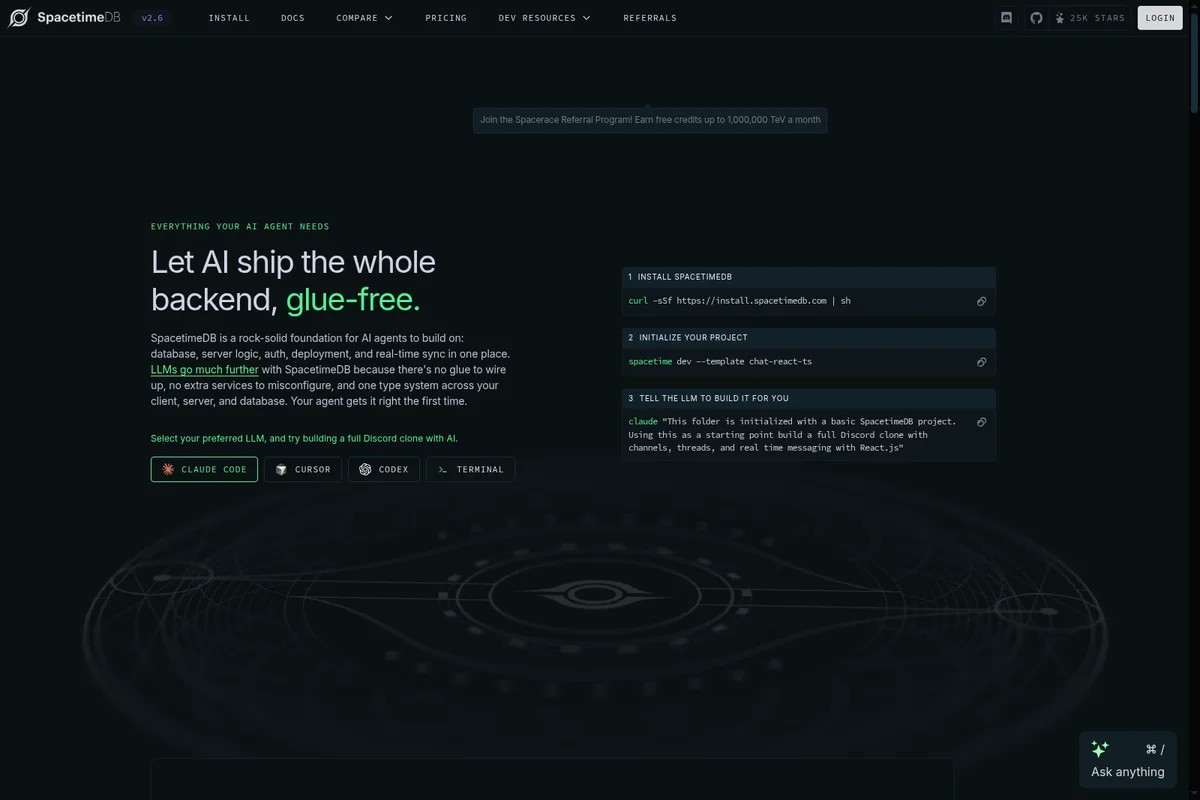
Rapidly set up your AI agent's entire backend, glue-free, with guided LLM integration.
SpacetimeDB Review: Tooliverse Consensus




Based on 305 verified reviews across 3 platforms,
combined with Tooliverse's expert analysis
Logic runs inside the database here, so clients subscribe to live data without a separate server, ORM, or sync layer. Reviewers credit that collapse of the stack for taking the networking code and race conditions out of multiplayer games, and they like writing the logic in Rust or TypeScript. The catches are real: the open-source build stays on a single node, the benchmark claims draw skepticism, and energy-pack billing confuses people. Developers coming from REST habits should expect a steep mental reset.
Bottom line: A top-tier backend for real-time multiplayer games that replaces the server-database stack with one engine, though single-node open-source limits and disputed benchmarks mean teams should validate performance before committing.
SpacetimeDB | Key Specs
- Platforms
- Web, API (CLI and SDKs)
- Pricing Model
- Freemium ($0-250/mo, usage-based overage) See plans
- Security
- Role-based access control, SSO, DDOS protection See details
- Integrations
- React, Next.js, Node.js + 9 more
Wins
- •Collapses the traditional server-database-client architecture into a single, high-performance enginementioned in 142 reviews
- •Enables seamless real-time state synchronization for multiplayer games without manual networking codementioned in 128 reviews
- •Allows developers to write complex application logic in Rust or TypeScript directly in the DBmentioned in 115 reviews
Watch-Outs
- •Open-source version currently lacks support for horizontal scaling beyond a single nodementioned in 78 reviews
- •Benchmark claims have faced significant technical skepticism and scrutiny from the communitymentioned in 65 reviews
- •Pricing model based on "energy packs" is often described as confusing and unpredictablementioned in 54 reviews
SpacetimeDB Features 2026
Server logic inside the database
Run typed reducer functions in Rust, C#, or TypeScript directly in the database, callable by clients.
Real-time subscriptions
Clients subscribe to queries and receive automatic updates, maintaining a local cache with row callbacks.
Type-safe API
One type system across client, server, and database, generated from your schema.
One-command cloud deployment
Deploy with spacetime publish to Maincloud, a serverless platform that scales to zero.
SpacetimeDB User Reviews
Selected Reviews
"Finally, a way to handle multiplayer state without losing my mind over race conditions. The relational aspect makes managing game state so much cleaner than NoSQL."
"The WASM-based execution for logic is clever. It ensures the DB stays performant even with complex logic running inside, and the Rust integration is seamless."
"The database itself doesn't horizontally scale beyond a single node yet. Layered on top are known anti-patterns around using stored procs that aren't fully addressed."
More from the Community
"I had considered using Nakama, but given how complicated the setup is, I think I'll go with your solution, which is really affordable for an indie developer."
"SpacetimeDB fits into a tech genre I call "universe brain reorgs" - structural re-arrangements that unlock wild performance. The challenge is re-aligning your thinking."
"SpacetimeDB + Godot makes multiplayer way easier than I expected. The reduction in networking code is undeniable and the sync is rock solid."
"I simply don't trust the benchmarks. They claim 1,000x throughput of Postgres, which is the kind of hype MongoDB used to do by dropping consistency."
"Ten months ago, I wrote about how SpacetimeDB was helping me turn my childhood MMORPG dream into reality. The foundation actually supported a full live game."
"I dislike how annoying it is to figure out pricing. Instead of dollar terms you buy "energy packs" and factor in consumption for every operation."
"The CLI tool is powerful but the error messages when a deployment fails are sometimes too cryptic to act on immediately without checking Discord."
SpacetimeDB Pricing 2026
View SourceThe free tier is generous for prototyping, with 2,500 TeV of monthly credit and databases that pause after a week of inactivity. Pro at $25/month is the one to pick for anything with real players: replication, backups, an SLA, and 100,000 TeV of credit. Past that allowance, billing runs on TeV energy units, so watch consumption on busy databases before assuming the monthly price is the final bill.
SpacetimeDB In-Depth Review 2026

Built by Clockwork Labs, SpacetimeDB runs application logic inside the database itself. Developers write modules in Rust, C#, or TypeScript, clients connect straight to the database, and they subscribe to queries that stream live changes into a local cache. Auth is built in, and a single publish command deploys everything to Maincloud, a serverless platform that scales to zero. The project has 25K GitHub stars and backing from Andreessen Horowitz and Supercell, and BitCraft Online runs its entire backend on it.
What It's Like Day-to-Day
The daily rhythm centers on reducers, typed functions that live in the database and that clients call directly. Tables are relational with ACID transactions, every reducer is atomic, and client bindings are generated from the schema, so the same types carry across Rust, C#, TypeScript, Unity, and Unreal. Reddit users describe Godot projects where the drop in networking code was obvious and the sync held up, which fits the 128 reviews that single out state synchronization.
Subscriptions do the heavy lifting on the client.
SpacetimeDB Security & Compliance
Security Features
- Role-based access control
- Single sign-on
- DDOS protection (paid plans)
SpacetimeDB: Frequently Asked Questions (FAQs)
Is SpacetimeDB free to use?
Yes, Maincloud Free costs $0/month and includes 2,500 TeV of free credit (~3,000,000 function calls), unlimited monthly active users, and community support. The source is also available on GitHub.
How much does SpacetimeDB Maincloud cost?
Maincloud Pro costs $25/month and Team costs $250/month, with Free at $0 and Enterprise custom. Pro and Team include 100,000 and 250,000 TeV of monthly credit, then 2,592 TeV per $.
How does SpacetimeDB Enterprise pricing work?
Enterprise pricing combines a monthly fee during development with per-node charges in production. During development, SpacetimeDB provides direct engineering support, and when deploying to production it charges per node so cost scales with usage.
Do SpacetimeDB databases have resource limits?
Maincloud databases are limited only by the physical capacity of the machines they run on. These are enterprise-grade machines with upwards of 80 cores and 256 GB of memory.
SpacetimeDB Integrations
| React | Next.js | Node.js |
| Bun | Deno | Svelte |
| Vue | Nuxt | Remix |
| Unity | Unreal Engine | Godot |
SpacetimeDB: Verified Data Sheet
| # | Label | Data Point |
|---|---|---|
| [1] | SpacetimeDB Consensus: 8.58/10 | SpacetimeDB is a highly-rated tool among AI coding tools in the Tooliverse index, with a consensus score of 8.58/10 across 305 verified reviews. |
| [2] | What is SpacetimeDB | SpacetimeDB, built by Clockwork Labs, is a reactive backend platform combining database, server logic, auth, and real-time sync. It has 25K GitHub stars, with Maincloud pricing from free to $25/month Pro. |
| [3] | Tooliverse Consensus on SpacetimeDB | Logic runs inside the database here, so clients subscribe to live data without a separate server, ORM, or sync layer. Reviewers credit that collapse of the stack for taking the networking code and race conditions out of multiplayer games, and they like writing the logic in Rust or TypeScript. The catches are real: the open-source build stays on a single node, the benchmark claims draw skepticism, and energy-pack billing confuses people. Developers coming from REST habits should expect a steep mental reset. |
| [4] | SpacetimeDB Verdict | SpacetimeDB bottom line: A top-tier backend for real-time multiplayer games that replaces the server-database stack with one engine, though single-node open-source limits and disputed benchmarks mean teams should validate performance before committing. |
| [5] | Maincloud Free: Free | SpacetimeDB offers a Maincloud Free tier with 2,500 TeV free credit/month (~3,000,000 function calls), ~12.5 GB egress bandwidth, and ~1 GB table storage, making it accessible at no cost. |
| [6] | Logic in Rust, C#, or TypeScript in the DB | SpacetimeDB lets developers write complex application logic directly in the database in Rust, C#, or TypeScript, a capability praised in 115 user reviews, with type-safe client bindings generated from the schema. |
| [7] | Affordable backend for indie game devs | SpacetimeDB offers an affordable, simplified backend for indie game developers, according to 98 user reviews, with Maincloud Free at $0/month and Maincloud Pro at $25/month. |
| [8] | High transaction throughput vs. relational DBs | SpacetimeDB delivers transaction throughput that reviewers say significantly outperforms traditional relational databases, a point raised in 87 user reviews, with published benchmark code available on GitHub. |
| [9] | Maincloud Pro: $25/month | Clockwork Labs (Clockwork Laboratories, Inc.)'s SpacetimeDB Maincloud Pro empowers users with 100,000 TeV free credit/month (~120,000,000 function calls) for just $25 monthly, significantly expanding on the free tier's capabilities. |
| [10] | Server, database, client in one engine | SpacetimeDB collapses the traditional server, database, and client stack into a single engine, a strength cited in 142 user reviews, with application logic running as atomic reducers inside a relational database with ACID transactions. |
| [11] | No horizontal scaling beyond one node | SpacetimeDB's open-source version does not support horizontal scaling beyond a single node, according to 78 user reports, though Maincloud databases can use machines with upwards of 80 cores and 256 GB of memory. |
| [12] | Benchmark claims face skepticism | SpacetimeDB's benchmark claims have drawn technical skepticism from the developer community, according to 65 user reports, with critics questioning the published throughput multiples against Postgres. |
| [13] | Enterprise: Role-based access control | SpacetimeDB provides enterprise security with Role-based access control, Single sign-on, and DDOS protection (paid plans). |
| [14] | "Universe brain reorgs" with wild performance | SpacetimeDB fits what a Hacker News reviewer calls a tech genre of "universe brain reorgs", structural re-arrangements that deliver wild performance but require re-aligning how you think. |