
Semantic Scholar Review 2026 - AI Research Tool
Verified Jun 18, 2026 by Tooliverse Editorial
Semantic Scholar uses AI to help researchers navigate 214 million papers across all fields of science. Unlike traditional search engines, it extracts meaning from papers, identifies connections, and surfaces insights like TLDRs and highly influential citations—making literature review dramatically faster.
Getting Started with Semantic Scholar Academic Graph API [Webinar]
Modern Literature Review AI Tools That Save Hours SEMANTIC SCHOLAR NOTEBOOKLM, CONSENSUS
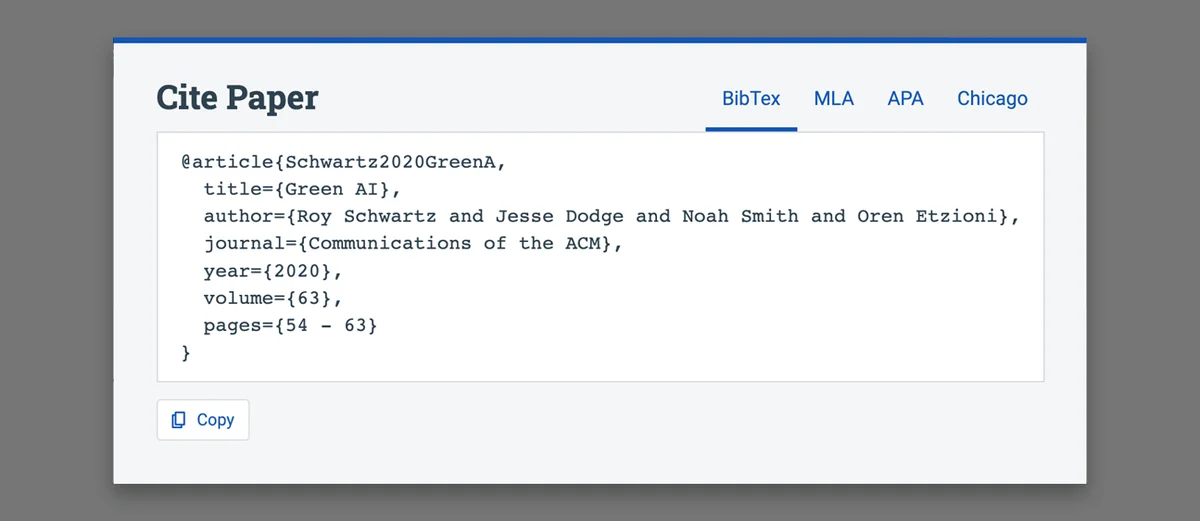
Generate and copy citations in multiple formats like BibTex, MLA, APA, and Chicago.
Discover over 230 million research papers with AI-powered search.
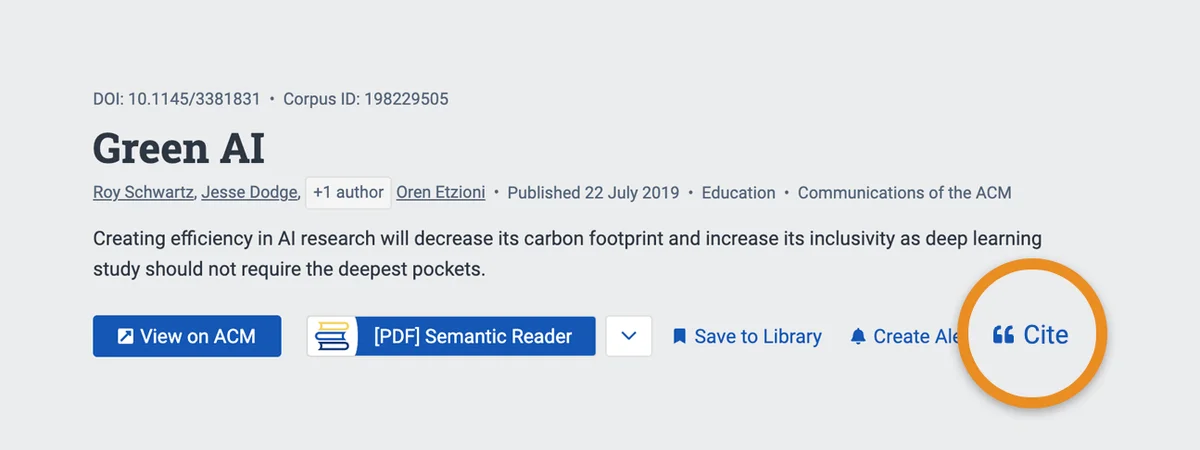
Generate citations in various formats directly from the article page.
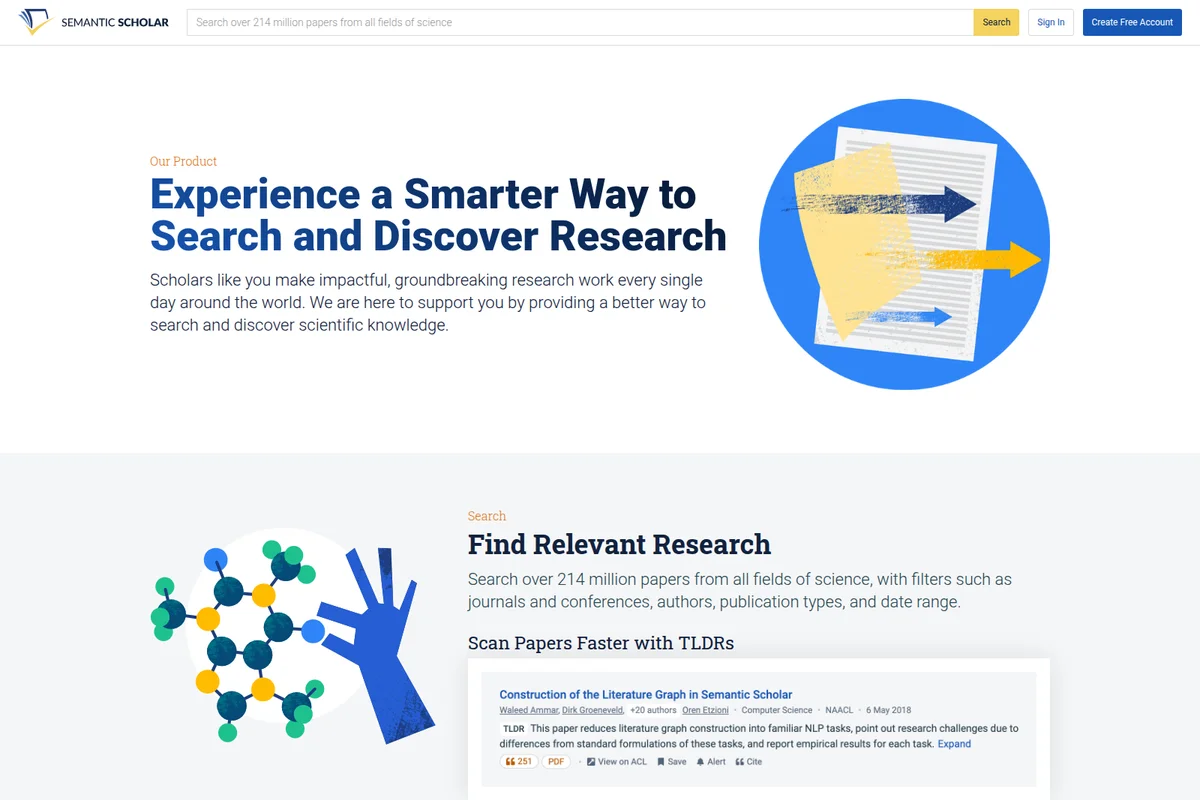
Experience intelligent research search and faster paper scanning with TLDRs.
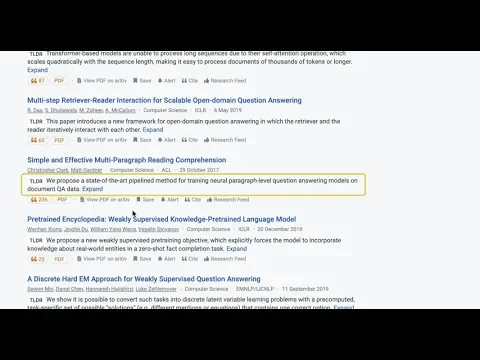
Quickly grasp paper content with AI-generated TLDR summaries.
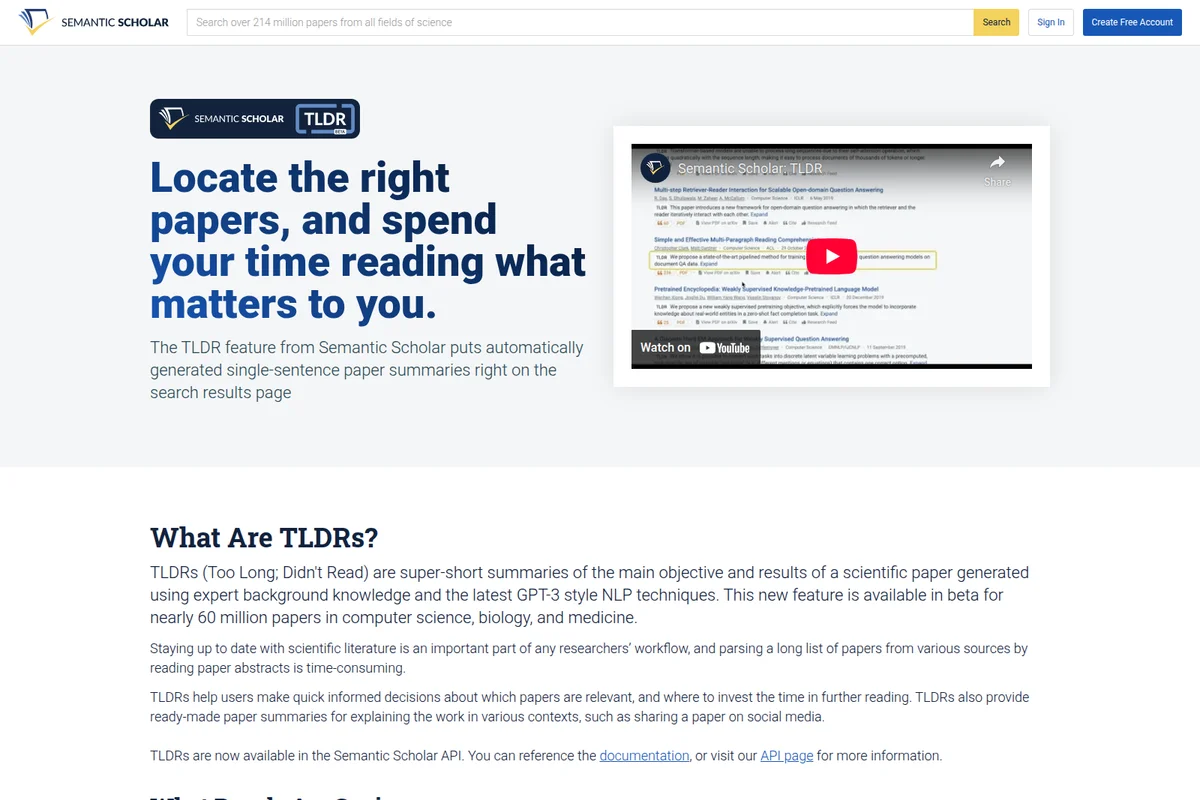
Locate relevant papers faster with AI-generated single-sentence summaries.
Visualize the intelligent extraction and flow of key information from research papers.
Semantic Scholar Review: Tooliverse Consensus





Based on 280 verified reviews across 6 platforms,
combined with Tooliverse's expert analysis
Semantic Scholar functions as an AI-augmented discovery engine that prioritizes conceptual understanding over keyword matching, fundamentally accelerating how researchers navigate academic literature. The TLDR summaries and Highly Influential Citations filter deliver the 10x efficiency gains that matter most in literature reviews, while Research Feeds learn reading preferences faster than competing systems. Coverage gaps in non-STEM fields are the primary limitation, but for computer science, biology, and medicine researchers, the semantic search and citation analysis capabilities represent a clear step beyond traditional academic databases.
Bottom line: A leading academic search engine that transforms literature review efficiency through AI-powered summaries and citation impact analysis, though researchers outside STEM fields will find coverage gaps compared to broader databases.
Semantic Scholar | Key Specs
Wins
- •AI-powered TLDR summaries provide instant clarity on paper objectives and resultsmentioned in 214 reviews
- •Highly Influential Citations filter effectively separates foundational research from peripheral mentionsmentioned in 188 reviews
- •Semantic Reader features helpful inline definitions that reduce context switching during readingmentioned in 156 reviews
Watch-Outs
- •Coverage gaps exist in non-STEM fields and non-English academic publicationsmentioned in 64 reviews
- •AI-generated summaries occasionally miss technical nuances in highly specialized niche domainsmentioned in 52 reviews
- •Mobile web interface lacks the advanced filtering and reading features of desktopmentioned in 41 reviews
Semantic Scholar Features 2026
AI-Generated TLDRs
Automatically generated single-sentence summaries of papers using GPT-3 style NLP techniques. Available for nearly 60 million papers in computer science, biology, and medicine, helping researchers quickly determine paper relevance without reading full abstracts.
Highly Influential Citations
Machine learning model identifies citations where the cited publication has significant impact on the citing work, analyzing factors including citation count and surrounding context. Helps researchers focus on the most meaningful citations rather than all mentions.
Ask This Paper
Generative AI feature using OpenAI's GPT-3.5-turbo-16k to answer questions about papers. Provides AI-generated answers with supporting statements from the original text, helping researchers quickly extract key information without reading entire papers.
Semantic Scholar API
Free REST API providing programmatic access to 214M papers, 2.49B citations, 79M authors, SPECTER2 embeddings, and recommendations. Includes Academic Graph, Recommendations, and Datasets endpoints with monthly updated bulk downloads.
Semantic Scholar User Reviews
Selected Reviews
"The Research Feeds are surprisingly good at finding relevant new preprints I would have missed on ArXiv. It learns my interests much faster than other recommendation engines I've tried."
"The TLDR feature is a game-changer for literature reviews. I can scan 50 papers in the time it used to take for 5. It really helps me decide which PDFs are actually worth a deep dive."
"I've noticed some gaps in social science coverage compared to Google Scholar, but for CS it's unbeatable. The semantic search actually understands the concepts, not just the keywords."
More from the Community
"Highly Influential Citations help me find the foundational papers without getting lost in the noise of self-citations. It's the best way to map out a new research area quickly."
"Semantic Reader's inline definitions are great, but the AI summaries can be a bit generic for niche physics topics. Sometimes they miss the specific methodology that makes a paper unique."
"Love that it's free and non-profit. It feels like a tool built for researchers, not for shareholders. The API is also incredibly robust for building my own analysis scripts."
"The mobile experience is frustrating. Trying to filter results on a phone is a nightmare compared to the desktop site. I usually just save papers to my library and wait until I'm at my PC."
"Integration with Zotero is seamless. One click and the metadata is perfectly captured in my library. It saves me so much time on manual entry and formatting."
"Highly Influential Citations help me find the foundational papers without getting lost in the noise of self-citations. It's the best way to map out a new research area quickly."
"Semantic Reader's inline definitions are great, but the AI summaries can be a bit generic for niche physics topics. Sometimes they miss the specific methodology that makes a paper unique."
"Love that it's free and non-profit. It feels like a tool built for researchers, not for shareholders. The API is also incredibly robust for building my own analysis scripts."
"The mobile experience is frustrating. Trying to filter results on a phone is a nightmare compared to the desktop site. I usually just save papers to my library and wait until I'm at my PC."
"Integration with Zotero is seamless. One click and the metadata is perfectly captured in my library. It saves me so much time on manual entry and formatting."
"The 'Ask This Paper' feature is a huge time saver when I need to find a specific result in a 30-page PDF. It's like having a conversation with the paper itself."
"The citation graph visualization is the best way to see how an idea has evolved over decades. It makes the 'genealogy' of a concept very easy to visualize."
"It's a solid tool, but I really miss having complex boolean search options for very specific systematic reviews. Sometimes the semantic search is a bit too broad."
"The AI-powered discovery is much more relevant than keyword matching. It actually understands the context of my search and suggests papers that are conceptually related."
"The 'Ask This Paper' feature is a huge time saver when I need to find a specific result in a 30-page PDF. It's like having a conversation with the paper itself."
"The citation graph visualization is the best way to see how an idea has evolved over decades. It makes the 'genealogy' of a concept very easy to visualize."
"It's a solid tool, but I really miss having complex boolean search options for very specific systematic reviews. Sometimes the semantic search is a bit too broad."
"The AI-powered discovery is much more relevant than keyword matching. It actually understands the context of my search and suggests papers that are conceptually related."
Semantic Scholar Pricing 2026
There's no pricing decision to make here—everything is free. The full platform, all 214 million papers, AI summaries, citation analysis, Research Feeds, and API access operate at no cost as a non-profit research tool. The API has rate limits (1 request per second with a free key, 1000 per second shared if unauthenticated), but those are technical constraints, not paywalls. If you need higher API limits for a large-scale research project, you request them from the Semantic Scholar team rather than pulling out a credit card.
Semantic Scholar In-Depth Review 2026

This AI-powered academic search engine indexes 214 million papers across all scientific fields, operated by the Allen Institute for AI as a non-profit alternative to commercial databases. It runs entirely in your browser at no cost, with AI-generated summaries, citation impact analysis, and personalized recommendations that learn what matters to your research. The semantic search understands concepts, not just keywords, surfacing papers based on meaning rather than exact phrase matching.
What It's Like Day-to-Day
The TLDR summaries hit you immediately on search results: single-sentence distillations of each paper's core contribution and findings. One Product Hunt reviewer captured the efficiency gain perfectly: "I can scan 50 papers in the time it used to take for 5. It really helps me decide which PDFs are actually worth a deep dive." The AI reads the full text and extracts the essential claim, saving you from abstract-skimming fatigue. When you're mapping a new research area, that 10x acceleration in initial screening is the difference between a week of reading and an afternoon.
The Highly Influential Citations filter changes how you navigate citation networks.
Semantic Scholar Security & Compliance
Privacy Commitments
- Non-profit organization (Ai2) - not driven by commercial interests
- Does not collect sign-in information (uses third-party authentication)
Semantic Scholar: Frequently Asked Questions (FAQs)
What is the advantage of using Semantic Scholar instead of other academic search engines?
Semantic Scholar is a free, AI-powered search and discovery tool that uses machine learning to extract meaning and identify connections from within papers, then surfaces these insights to help scholars gain in-depth understanding quickly. The mission is to accelerate scientific breakthroughs by helping scholars locate and understand the right research, make important connections, and overcome information overload.
How many articles does Semantic Scholar currently index?
Semantic Scholar indexes over 214 million papers from all fields of science. The corpus is constantly expanding with new content added daily.
Does Semantic Scholar offer programmatic access to its data through an API or downloadable dataset?
Yes, Semantic Scholar provides the S2AG RESTful API at semanticscholar.org/product/api, S2AG downloadable datasets updated monthly at api.semanticscholar.org/corpus, Academic Conference Peer Review Service, and S2ORC corpus for NLP and text mining at github.com/allenai/s2orc. All are free for universities and organizations.
What are the benefits of creating an account?
Creating a Semantic Scholar account enables you to create email alerts for new papers, generate research feeds for personalized recommendations, save papers to revisit in a library, and claim an author page to manage your details and papers. You do not need an account to access papers on Semantic Scholar.
Semantic Scholar Integrations
| Zotero | GetFTR | LibKey |
| Open Athens | eduGAIN | InCommon |
| OpenAI GPT-3.5-turbo |
Semantic Scholar: Verified Data Sheet
| # | Label | Data Point |
|---|---|---|
| [1] | Semantic Scholar Consensus: 9.08/10 | Semantic Scholar is one of the highest-rated AI research tools in the Tooliverse index, with a consensus score of 9.08/10 across 280 verified reviews. |
| [2] | What is Semantic Scholar | Semantic Scholar, operated by the Allen Institute for AI (Ai2), is a free AI-powered academic search engine indexing 214 million papers across all scientific fields. The platform serves researchers worldwide with AI-generated TLDRs, highly influential citations, and a free API for developers. |
| [3] | Tooliverse Consensus on Semantic Scholar | Semantic Scholar functions as an AI-augmented discovery engine that prioritizes conceptual understanding over keyword matching, fundamentally accelerating how researchers navigate academic literature. The TLDR summaries and Highly Influential Citations filter deliver the 10x efficiency gains that matter most in literature reviews, while Research Feeds learn reading preferences faster than competing systems. Coverage gaps in non-STEM fields are the primary limitation, but for computer science, biology, and medicine researchers, the semantic search and citation analysis capabilities represent a clear step beyond traditional academic databases. |
| [4] | Semantic Scholar Verdict | Semantic Scholar bottom line: A leading academic search engine that transforms literature review efficiency through AI-powered summaries and citation impact analysis, though researchers outside STEM fields will find coverage gaps compared to broader databases. |
| [5] | Free: Free | Semantic Scholar operates on a completely Free tier providing access to 214 million papers and AI-generated TLDRs for 60M papers, making advanced AI research tools accessible at no cost. |
| [6] | AI TLDRs accelerate literature review 10x | Semantic Scholar provides AI-powered TLDR summaries for nearly 60 million papers across computer science, biology, and medicine, enabling researchers to scan 50 papers in the time previously required for 5, according to user validation across 214 reviews. |
| [7] | Highly Influential Citations filter foundational research | Semantic Scholar employs machine learning to identify Highly Influential Citations that meaningfully shaped citing work rather than peripheral mentions, helping researchers map foundational research in new domains without noise from self-citations, validated by 188 user reviews. |
| [8] | Free access to 214M+ papers | Semantic Scholar provides completely free access to over 214 million papers with no paywalls, subscription fees, or API usage costs for basic access, operating as a non-profit research tool rather than a commercial platform, confirmed by 118 user reviews. |
| [9] | Inline definitions reduce context switching | Semantic Scholar's Semantic Reader provides inline definitions and term explanations that reduce context switching during paper reading, eliminating the need to constantly search for unfamiliar terminology, according to 156 user reviews. |
| [10] | Limited non-STEM and non-English coverage | Semantic Scholar exhibits coverage gaps in non-STEM disciplines and non-English academic publications compared to broader databases like Google Scholar, limiting effectiveness for social sciences and humanities research, according to 64 user reports. |
| [11] | AI summaries miss niche technical nuances | Semantic Scholar's AI-generated summaries occasionally miss technical nuances and specific methodological details in highly specialized niche domains, requiring researchers to verify critical details in the full text, noted in 52 user reviews. |
| [12] | Privacy: Non-profit organization (Ai2) - not driven by commercial interests | Semantic Scholar privacy protections include Non-profit organization (Ai2) - not driven by commercial interests and Does not collect sign-in information (uses third-party authentication). |
| [13] | TLDRs accelerate literature scanning 10x | A verified Product Hunt reviewer noted that Semantic Scholar's TLDR feature "is a game-changer for literature reviews. I can scan 50 papers in the time it used to take for 5. It really helps me decide which PDFs are actually worth a deep dive." |
Best Semantic Scholar Alternatives
Elicit
AI-powered research assistant that helps scientists analyze millions of papers and generate evidence-based reports in minutes.
SciSpace
Discover, analyze, and write scientific literature faster with AI that understands research.
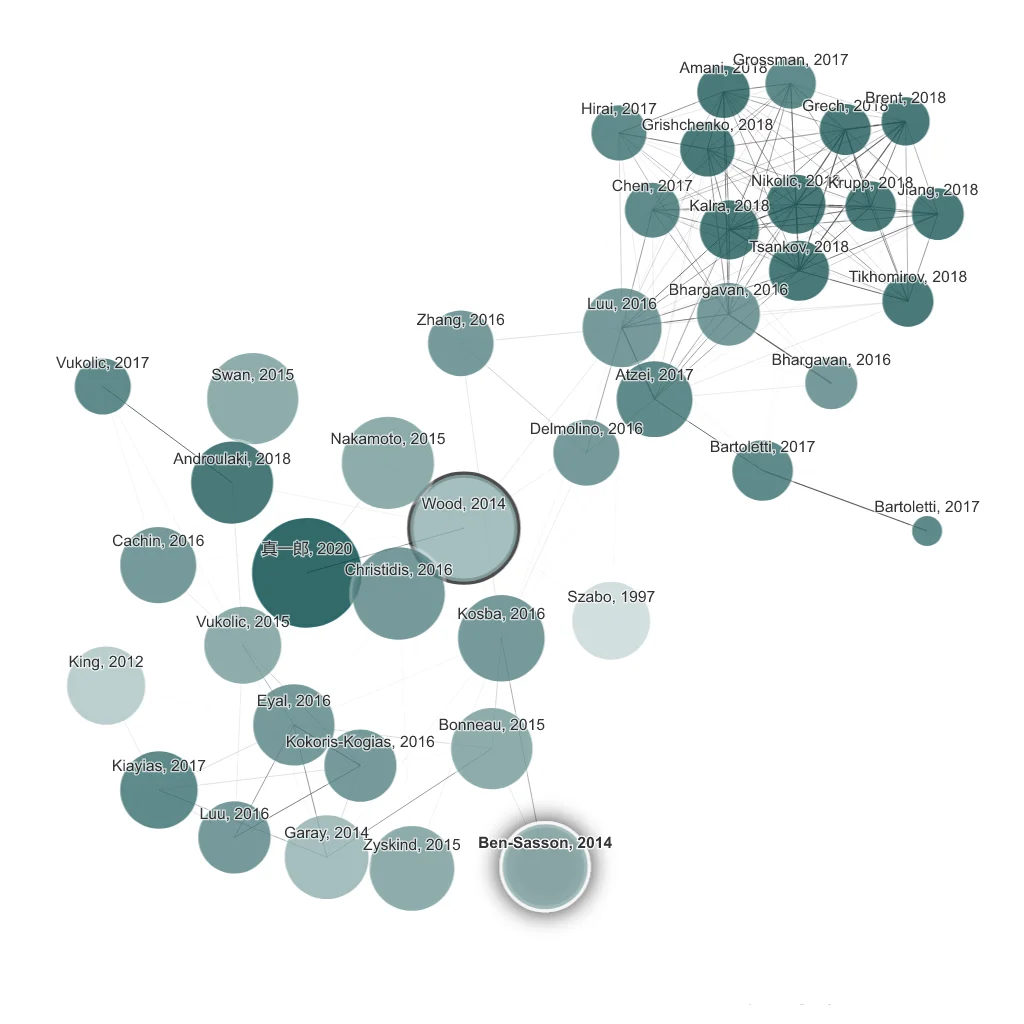
Connected Papers
Discover academic papers visually—explore research fields through interactive graphs that reveal hidden connections.